
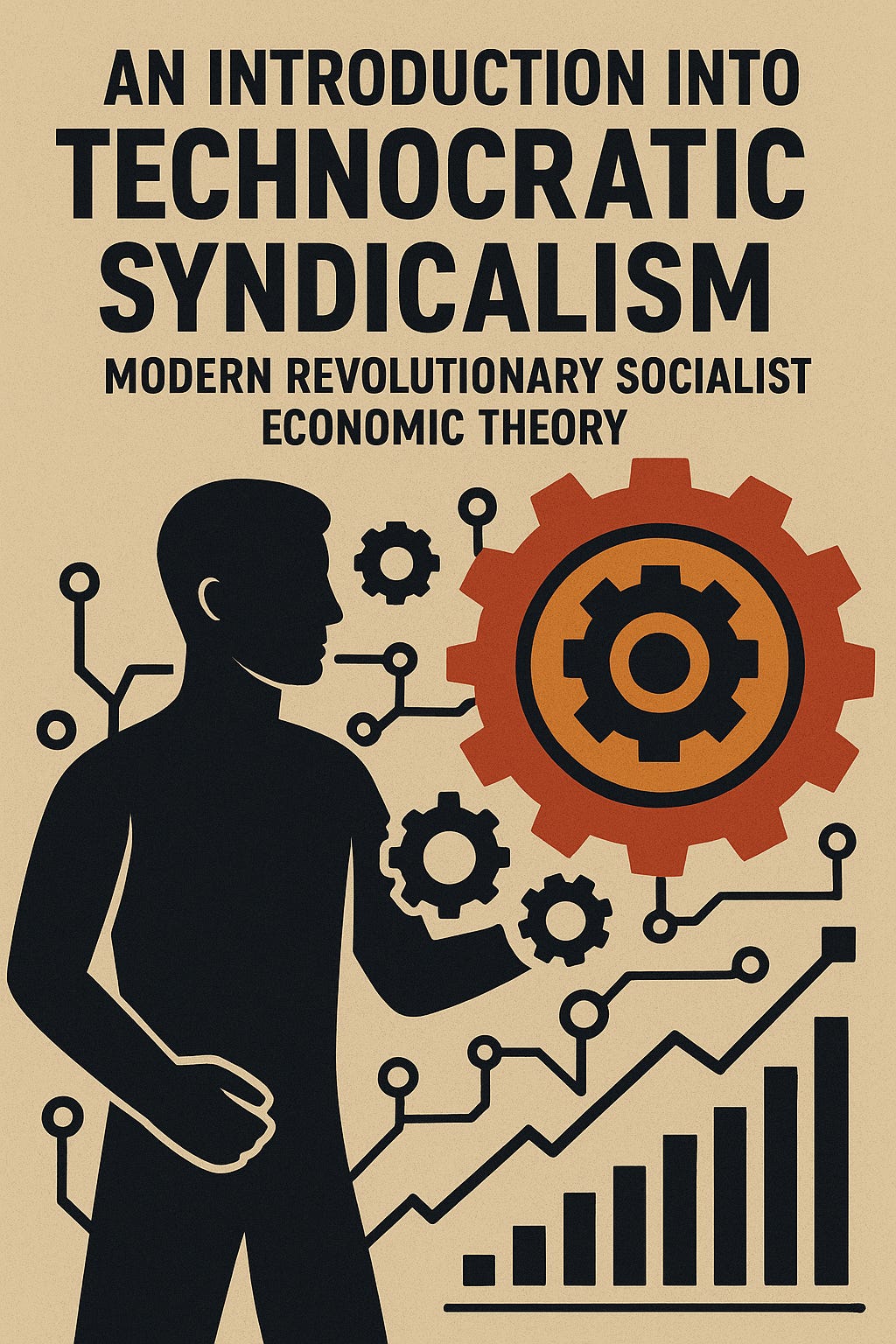
An Introduction Into Technocratic Syndicalism
Modern Revolutionary Socialist Economic Theory

Introduction: The Crisis of the Old Paradigms
The twenty-first century marks the terminal phase of industrial capitalism.
Globalization, automation, and ecological collapse have exposed the fundamental irrationality of a system whose continued survival depends on perpetual growth within a finite environment. The contradictions that Marx and Engels identified in the mid-nineteenth century, between socialized production and private appropriation, between technological progress and human immiseration, have not been resolved. They have become planetary.
The modern capitalist economy functions as a vast machine for the dissipation of energy and human potential. It converts living labor, fossil fuels, and natural resources into profit through the organized production of waste. Every innovation that increases productivity simultaneously expands consumption, debt, and environmental degradation. The system operates according to a single blind compulsion: accumulate or perish.
Yet beneath this crisis lies a new possibility: the scientific and organizational tools developed by capitalism have reached a stage where conscious coordination of production has become not only possible, but necessary. Automation, artificial intelligence, and cybernetic networks, the very technologies that today reproduce exploitation, also contain the technical foundations of a post-capitalist society.
Technocratic Syndicalism, emerges as the revolutionary synthesis of these conditions. It is a modern socialist economic theory that unites the Marxian critique of political economy with cybernetic science, energy analysis, and syndicalist democracy. It aims not to return to the past forms of socialism, bureaucratic centralism, or market socialism, but to advance toward a new stage: a cybernetic communism grounded in democratic planning, scientific coordination, and human liberation.
The Theoretical Foundations: Marxism, Thermodynamics, and Action
Technocratic Syndicalism begins with Marx’s fundamental insight: that all social formations are expressions of the productive forces and their relations of control. Every mode of production embodies a specific way in which humanity organizes its metabolic interaction with nature. When this organization becomes incompatible with the further development of those forces, revolution becomes the material necessity of history.
In Marx’s time, the central productive force was human labor organized through industrial machinery. Hence, the Labor Theory of Value (LTV) provided the key to understanding capitalism’s motion: value was determined by the socially necessary labor time (SNLT) required to produce commodities. But in the twenty-first century, with the rise of automation and digital production, living labor is no longer the primary source of productive energy. Machines, algorithms, and computation now embody vast quantities of dead labor, stored human energy accumulated in technological form.
To comprehend this transformation, Technocratic Syndicalism extends Marx’s LTV into the Energy Theory of Value (ETV).
Here, value is understood as the socially necessary energy expenditure, both human and mechanical, required to reproduce a good or service. Labor remains one form of energy transfer among others; it is no longer the exclusive source of value, but part of a universal energetic process governed by the laws of thermodynamics.
This reinterpretation does not reject Marx’s analysis; it completes it. Where classical Marxism described the social laws of labor under the commodity form, Technocratic Syndicalism describes the material laws of energy under the post-commodity form. It unites historical materialism with physical materialism.
This also defines its philosophical character as Actionist Marxism. The revolution is not an inevitable product of economic collapse but a conscious act, an organized intervention that redirects the productive forces toward social equilibrium. In this sense, socialism is not merely an economic transition but an energetic reorientation of civilization. It transforms the social metabolism from a chaotic, entropic system into a planned, self-correcting, cybernetic one.
The Law of Value in Transition: From Market Chaos to Cybernetic Rationality
Under capitalism, the Law of Value operates as the unconscious regulator of production. It dictates that commodities exchange according to the average socially necessary labor time embedded in them. Yet because no one knows the total system, production is guided by price fluctuations, an indirect and chaotic feedback loop that produces both shortage and waste.
Technocratic Syndicalism reinterprets this law through the lens of cybernetic rationality.
When production and distribution can be measured in real-time, and energy inputs can be recorded through automated systems, the market’s chaotic signals become obsolete. Data replaces price as the indicator of necessity; feedback replaces competition as the mechanism of coordination.
In this system, the Law of Value is not abolished but consciously administered.
Value becomes a planning variable, a dynamic function defined by energy efficiency and social utility. The equation
V = E / U,
Where E represents energy expenditure and U represents social utility, expresses this new relation.
When V rises, it indicates inefficiency and waste; when V falls, it signifies rational coordination. Thus, the law of motion, once blind under capital, becomes self-aware under socialism.
This transformation establishes a new scientific foundation for political economy: a Cybernetic Economy. Each productive unit, factory, cooperative, or syndicate, records its energy and labor inputs through digital systems linked to a broader planning network. Input-output matrices, similar to Leontief’s models, calculate the total direct and indirect energy embodied in every good.
Instead of markets determining production through crises, planning algorithms continuously adjust supply to demand through feedback:
xₜ₊₁ = xₜ + α(Δ)
Where Δ represents imbalance and α the system’s sensitivity coefficient.
This ensures real-time equilibrium and replaces the “invisible hand” with the visible mind of collective reason.
The economy becomes self-regulating, dynamic, and transparent, a living organism guided by cybernetic feedback rather than market anarchy.
The Syndical Structure: Democracy and Coordination
Technocratic Syndicalism rejects both bureaucratic centralism and liberal decentralism. It does not propose a managerial technocracy but a syndical cybernetics, a dialectical unity of democratic participation and scientific administration.
At its foundation lie workers’ and community councils. Each syndicate governs its productive unit, determines labor allocation, and sets qualitative goals. Local decisions are aggregated through federations and transmitted to regional and national planning centers. These centers, in turn, operate as cybernetic processors, integrating data, energy flows, and feedback from below.
The structure is not pyramidal but networked. Each node, local, regional, or sectoral, both sends and receives information, maintaining autonomy within coordination. This replaces the state’s command hierarchy with a distributed web of councils and computational systems.
Planning boards composed of engineers, economists, and data scientists serve as technical organs rather than ruling classes. Their function is interpretive, not directive: translating collective decisions into operational models and returning data for verification.
This form of governance realizes what Marx called the “associated producers’ control over their own conditions of life.” It fuses technocratic efficiency with proletarian democracy. In it, expertise becomes collective property, knowledge is no longer monopolized but socialized, embedded within the very structure of decision-making.
The economic system thus functions as a technocratic web: a global metabolism of energy, labor, and data that is self-correcting, decentralized, and transparent.
Automation and the Abolition of Exploitation
Automation is the material key to socialism. It represents the historical culmination of humanity’s struggle to free itself from necessity. Yet under capitalism, automation serves the opposite end: it expels workers, concentrates wealth, and accelerates ecological collapse.
Technocratic Syndicalism transforms automation from a weapon of capital into an instrument of liberation. When the productive apparatus is socially owned and cybernetically coordinated, automation no longer produces unemployment but free time.
The measure of progress shifts from output to the ratio of free to necessary labor. As automation advances, the necessary labor tends toward zero. The individual no longer sells time to survive; time becomes the substance of freedom.
The social surplus, once extracted as profit, becomes collective potential, used to expand education, culture, and scientific exploration. The economy’s goal is not infinite growth but energetic equilibrium: the minimal expenditure of energy for maximal human flourishing.
Thus, exploitation, the extraction of unpaid labor, ceases not by decree but by material transformation. When energy accounting replaces money, when value is measured by thermodynamic efficiency rather than private profit, there exists no mechanism through which a class can appropriate surplus. The abolition of capital is no longer a moral aspiration; it becomes a physical inevitability within a cybernetically planned economy.
The Environmental Dimension: Entropy and Ecological Equilibrium
Capitalism’s ecological crisis is not accidental; it is a manifestation of its entropic logic. A system that equates value with accumulation must constantly expand, converting energy into waste. Every act of production increases global entropy, pollution, depletion, and climate instability.
Technocratic Syndicalism resolves this crisis by aligning economic law with natural law.
Because value is defined in energetic rather than monetary terms, planning inherently incorporates ecological limits. Each production process is evaluated not by profitability but by its entropy balance, its capacity to sustain energy flows without degrading the biosphere.
A rational society cannot exceed the regenerative capacity of its environment; it must circulate within it. The cybernetic economy, equipped with real-time environmental data, maintains this balance through feedback loops that adjust production to ecological feedback.
Hence, socialism becomes not merely a human emancipation but an ecological reconciliation. Humanity ceases to dominate nature and instead integrates into it as a conscious organ of planetary metabolism. The “realm of necessity,” in Marx’s words, is not escaped but harmonized.
Historical Continuity and Revolutionary Praxis
Technocratic Syndicalism does not arise from utopian speculation; it emerges from the real tendencies of the present. The seeds of cybernetic socialism already exist: in cooperative enterprises, open-source networks, time banks, and mutual aid systems that operate outside the market logic. The task of revolution is to link these prefigurative forms into a coordinated totality, to construct the infrastructure of socialism within the shell of capitalism.
This process follows the dialectical sequence outlined by Actionist theory:
Appropriation: The working class gains technical and informational control over production.
Coordination, Cybernetic planning replaces price signals as the mechanism of allocation.
Integration, Autonomous syndicates form a unified global network of rational production.
Revolution, in this view, is not merely the seizure of power but the transformation of the mode of operation. It is the reprogramming of the social machine. The proletariat ceases to be a class in itself and becomes a class for itself, a conscious agent governing the flow of energy, labor, and life.
The transition to socialism is thus both material and epistemic: a revolution in how society understands and organizes its own metabolism.
Conclusion: Toward a Post-Entropic Civilization
Technocratic Syndicalism represents the scientific and moral culmination of socialist thought. It preserves Marxism’s commitment to class emancipation, integrates syndicalism’s emphasis on direct democracy, and advances into the cybernetic and thermodynamic realities of the modern age.
It envisions a civilization where production is planned by need, guided by data, and balanced by ecology; where automation serves humanity instead of enslaving it; where value is measured not by profit but by energy and use; where the economy itself becomes an organ of collective intelligence.
The goal is not growth but equilibrium, not accumulation but harmony.
It is a civilization that no longer measures its success by the volume of things produced but by the freedom and consciousness it cultivates.
In this future, the dialectic between labor and capital, necessity and freedom, humanity and nature finds its resolution, not in the destruction of the machine but in its humanization. The machine becomes the instrument of reason, the medium of solidarity, and the extension of life itself.
Technocratic Syndicalism, therefore, is not a speculative ideology but a material necessity. It is the rational answer to the crisis of a world devoured by its own entropy, a blueprint for the next epoch of civilization: the post-capitalist, cybernetic society of equilibrium and freedom.