
What is The Dialectic Method? A Beginner’s Guide to the Logic of Revolution and Change
Understanding The Basics of Dialectics

What is The Dialectic Method?
A Comprehensive Insight Paper for Beginners
Introduction
Dialectics is not merely a method of thinking; it is a comprehensive worldview. It encompasses the science of interconnectedness, contradiction, motion, and development. From Heraclitus to Hegel and Marx, dialectical reasoning has transitioned from mystical philosophy to a rigorous materialist science that explains historical change. This paper aims to introduce beginners to dialectics by exploring key concepts such as logic, contradiction, materialism, and revolutionary transformation. We will examine foundational dialectical principles and trace how Marx and Engels turned Hegel’s dialectical idealism on its head, transforming it into a powerful tool for proletarian liberation.
The dialectical method represents humanity's most revolutionary approach to understanding the contradictory nature of reality and its potential for transformation. This method goes beyond mere philosophical speculation; it serves as a scientific instrument for analyzing both natural processes and social change. By investigating the development of the dialectical method from classical logic to materialist science, we uncover the theoretical foundations of revolutionary practice.
Part I: The Limits of Classical Logic
Empiricism, Rationalism, Determinism, and Anti-Determinism
Classical approaches to knowledge rest upon formal logic's static categories, creating fundamental limitations in comprehending reality's dynamic character.
Empiricism grounds knowledge in sensory experience, contributing valuable insights to scientific methodology. However, empiricism isolates phenomena from their interconnections, treating facts as discrete, unchanging entities. This approach fails to grasp the internal relations that constitute reality's essence, reducing complex processes to superficial appearances.
Rationalism privileges reason over experience, seeking truth through abstract deduction. While rationalism recognizes the role of logical thinking, it divorces concepts from material conditions, creating systems of pure thought disconnected from practical reality. Rationalist methods cannot comprehend how material conditions generate ideas and how ideas react upon material circumstances.
Determinism maintains that all events follow causal necessity, contributing to scientific understanding of natural laws. However, mechanical determinism treats causation as external force acting upon passive objects, neglecting internal contradictions that drive development. This approach cannot explain qualitative transformations or revolutionary leaps in natural and social processes.
Anti-Determinism reacts against mechanical determinism by emphasizing contingency and randomness. While recognizing that development is not mechanically predetermined, anti-determinism abandons scientific analysis of structural tendencies and contradictory forces. This position leads to voluntarism that ignores objective conditions constraining human action.
The various methods discussed are grounded in the fundamental laws of formal logic: identity (A = A), non-contradiction (A ≠ not-A), and the law of excluded middle (either A or not-A). These principles define phenomena as stable, self-identical entities that cannot possess contradictory attributes at the same time. While formal logic is useful in certain contexts, it falls short in capturing the dialectical nature of reality, which includes internal contradictions, interconnectedness, and the potential for change and transformation.
Part II: Dialectical Logic
The Logic of Motion and Contradiction
Dialectical logic emerges from recognizing that reality consists of processes, not things; relations, not isolated entities; contradictions, not static identities. This logic comprehends phenomena in their movement, interconnection, and internal opposition.
Dialectical logic operates through three fundamental principles:
Unity and Struggle of Opposites: Every phenomenon contains internal contradictions that constitute its essence and drive its development. These opposites exist in unity, they mutually presuppose and interpenetrate each other while simultaneously struggling against each other. The contradiction between opposing forces provides the internal source of motion and change.
Quantitative Change into Qualitative Change: Development proceeds through the accumulation of quantitative changes that eventually produce qualitative transformations. These qualitative leaps represent moments where accumulated contradictions resolve by generating new forms with different essential characteristics.
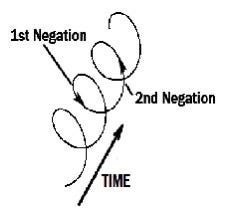
Negation of the Negation: Development occurs through successive negations that preserve and transform what came before at higher levels. Each stage contains the seeds of its own negation, but this negation is not mere destruction, it incorporates previous achievements while transcending their limitations.
Dialectical logic reveals that contradiction is not a logical error to be eliminated but reality's fundamental characteristic. Phenomena exist through their internal contradictions, develop by resolving these contradictions, and generate new contradictions in the process of transformation.
Part III: Hegelian Idealism
The Dialectic of Absolute Spirit
Georg Wilhelm Friedrich Hegel systematized dialectical logic as the movement of absolute consciousness or Spirit (Geist). For Hegel, reality unfolds through the self-development of the Idea, which achieves self-knowledge through historical process.
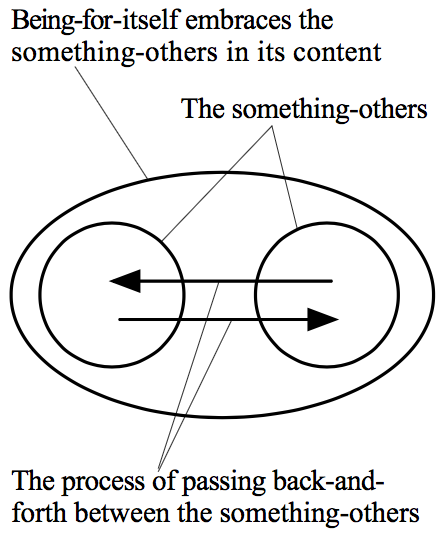
Hegel's dialectical method reveals how consciousness develops through encountering contradictions and resolving them at higher levels of understanding. The famous master-slave dialectic demonstrates how self-consciousness emerges through struggle and mutual recognition, showing that individual consciousness is fundamentally social.
However, Hegel's system remains trapped within idealism. He treats the movement of ideas as primary, with material reality serving as the external manifestation of spiritual development. History becomes the autobiography of absolute Spirit achieving self-consciousness through human activity.
This idealist framework inverts the actual relationship between consciousness and material reality. While Hegel's dialectical method provides powerful insights into the logic of development, his idealist foundation prevents scientific understanding of material processes and social transformation.
Part IV: Thesis/Antithesis/Synthesis
The Triadic Movement of Development
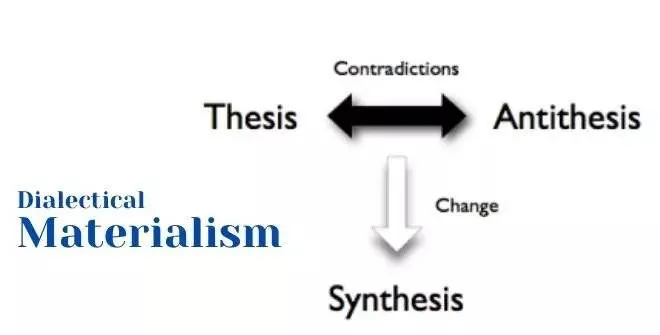
Hegel's dialectical process follows a triadic pattern often simplified as thesis-antithesis-synthesis, though Hegel himself rarely used these terms.
Thesis represents an initial position, condition, or stage of development that contains internal contradictions. This stage appears stable and self-sufficient but actually depends upon what it excludes or opposes.
Antithesis emerges as the negation of the thesis, revealing the contradictions inherent in the initial position. The antithesis is not external opposition but the development of contradictions already present within the thesis.
Synthesis resolves the contradiction between thesis and antithesis by incorporating elements of both at a higher level. This synthesis preserves what was rational in both previous stages while transcending their one-sided character.
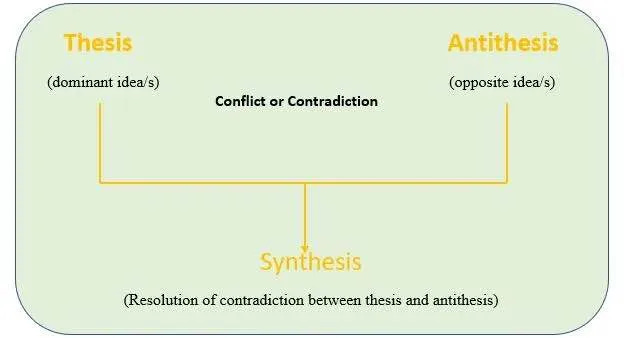
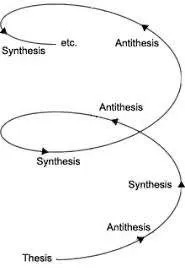
This triadic movement repeats endlessly, with each synthesis becoming a new thesis generating its own antithesis. The process drives toward absolute knowledge where all contradictions are finally resolved in pure self-consciousness.
While this schema captures important aspects of dialectical development, it can become mechanical if applied formulaically. Real dialectical processes are more complex than simple triadic patterns, involving multiple contradictions operating simultaneously at different levels.
Part V: Marx's Critique of Hegel
Standing Hegel on His Feet
Karl Marx recognized the revolutionary potential in Hegel's dialectical method while rejecting its idealist foundation. Marx's critique involved extracting the rational kernel from Hegel's mystical shell, transforming dialectical idealism into dialectical materialism.
Marx's fundamental insight was that material social relations, not the movement of ideas, constitute the driving force of historical development. As he declared in The German Ideology: "Life is not determined by consciousness, but consciousness by life."
This materialist inversion revealed how ideas arise from material conditions rather than generating them. Human consciousness develops through practical engagement with the material world, particularly through social labor that transforms both external nature and human nature itself.
Marx demonstrated that Hegel's dialectic, despite its idealist form, actually reflected the contradictory character of material reality. The dialectical movement that Hegel attributed to pure thought actually expressed the dialectical nature of material processes, especially the contradictions of capitalist production.
By grounding dialectics in material reality, Marx transformed it from speculative philosophy into scientific method for understanding and changing the world. This transformation created the theoretical foundation for revolutionary practice aimed at resolving social contradictions through organized struggle.
Part VI: Materialism
The Primacy of Material Reality
Marxist materialism affirms that material reality exists independently of human consciousness and constitutes the foundation from which consciousness emerges. This position differs fundamentally from both idealism and mechanical materialism.
Against Idealism: Material conditions generate ideas, not vice versa. Social being determines social consciousness, though consciousness possesses relative autonomy and can react back upon material conditions through practice.
Against Mechanical Materialism: Matter is not passive substance acted upon by external forces but inherently active, contradictory, and self-developing. Material reality consists of processes in constant motion and transformation.
Materialist dialectics recognizes that consciousness emerges from material processes while maintaining its specific character. Human consciousness can grasp reality's dialectical nature because consciousness itself develops dialectically through practical engagement with contradictory material conditions.
Practice as the Criterion of Truth: Abstract speculation divorced from material practice cannot grasp reality's essential characteristics. Only through active intervention in the world, through practice that unites theory and action, do humans come to understand reality's dialectical character and their capacity to transform it.
Lenin's Materialism and Empirio-Criticism defended this materialist foundation against subjective idealist attempts to dissolve the distinction between consciousness and external reality. Materialist dialectics maintains that objective material reality provides the foundation for all consciousness while recognizing consciousness's active role in understanding and transforming material conditions.
Part VII: Dialectics of Nature
Universal Dialectical Laws
Friedrich Engels extended dialectical materialism beyond human society to natural processes in Dialectics of Nature, demonstrating that dialectical laws operate throughout the material universe.
Natural Contradictions: Natural phenomena exhibit internal contradictions that drive their development. The wave-particle duality in physics, the unity of heredity and variation in biology, and the interpenetration of chemical elements in reactions all demonstrate dialectical principles operating in nature.
Qualitative Transformations: Natural processes involve quantitative changes that produce qualitative leaps. Water heated gradually undergoes quantitative change until reaching critical points where it transforms qualitatively into steam. Evolutionary development involves gradual changes punctuated by rapid speciation events.
Levels of Organization: Nature exhibits dialectical relationships between different levels of organization. Higher levels emerge from lower ones while possessing irreducible qualities. Biological processes emerge from chemical reactions while exhibiting properties absent from purely chemical systems.
Engels showed that natural science itself develops dialectically, with new discoveries revealing contradictions in existing theories and generating higher syntheses. The development of scientific knowledge follows dialectical patterns, moving from abstract to concrete understanding through the resolution of theoretical contradictions.
This extension of dialectics to nature provides the philosophical foundation for understanding human society as part of natural development while possessing its own specific characteristics. Social dialectics operates within natural dialectics while exhibiting qualitatively different forms of contradiction and development.
Part VIII: Dialectical Laws
The Fundamental Laws of Development
Marxist dialectics recognizes several interrelated laws that express general tendencies observable throughout natural and social reality:
Law of the Unity and Struggle of Opposites: All phenomena contain internal contradictions between opposing forces or tendencies. These opposites exist in unity, they mutually condition each otherw, hile struggling against each other. This contradiction provides the internal source of motion and development.
Law of the Transformation of Quantity into Quality: Gradual quantitative changes accumulate until reaching critical points where they produce qualitative transformations. These qualitative leaps represent moments where accumulated contradictions resolve by generating fundamentally new forms.
Law of the Negation of the Negation: Development proceeds through successive negations that preserve valuable elements while transcending limitations. Each stage generates its own negation, but this process is not cyclical repetition but spiral development toward higher forms.
Law of the Interpenetration of Opposites: Contradictory aspects of phenomena do not merely oppose each other externally but interpenetrate, with each containing elements of its opposite. This interpenetration creates the internal unity that makes dialectical development possible.
These laws are not rigid formulas to be mechanically applied but general principles derived from analyzing actual developmental processes. They provide guidance for concrete analysis while requiring specific investigation of particular contradictions operating in definite circumstances.
Part IX: Dialectical Materialism
The Worldview of Revolutionary Science
Dialectical materialism synthesizes materialist philosophy with dialectical method, creating a comprehensive worldview and scientific methodology. This synthesis transcends the limitations of both mechanical materialism and idealist dialectics.
Materialist Foundation: Reality consists of matter in motion, developing through internal contradictions. Consciousness emerges from material processes while possessing the capacity to understand and transform material conditions through practice.
Dialectical Method: All phenomena exist in interconnection, develop through internal contradictions, and undergo qualitative transformations. Understanding requires grasping these dialectical relationships rather than treating things in isolation.
Unity of Theory and Practice: Dialectical materialism is not contemplative philosophy but active science oriented toward transforming reality. Theory develops through practice and guides further practice in an ongoing dialectical process.
Revolutionary Character: By revealing the contradictory and temporary character of all social formations, dialectical materialism provides the theoretical foundation for revolutionary transformation. It shows how existing contradictions create the conditions for transcending present limitations.
Lenin emphasized that the essence of dialectics lies in recognizing contradiction as the fundamental principle of development. This recognition distinguishes dialectical materialism from all forms of metaphysical thinking that treat phenomena as fixed and eternal.
Part X: Historical Materialism
Dialectics Applied to Human Society
Historical materialism applies dialectical materialist method to human society and historical development, revealing the laws governing social transformation.
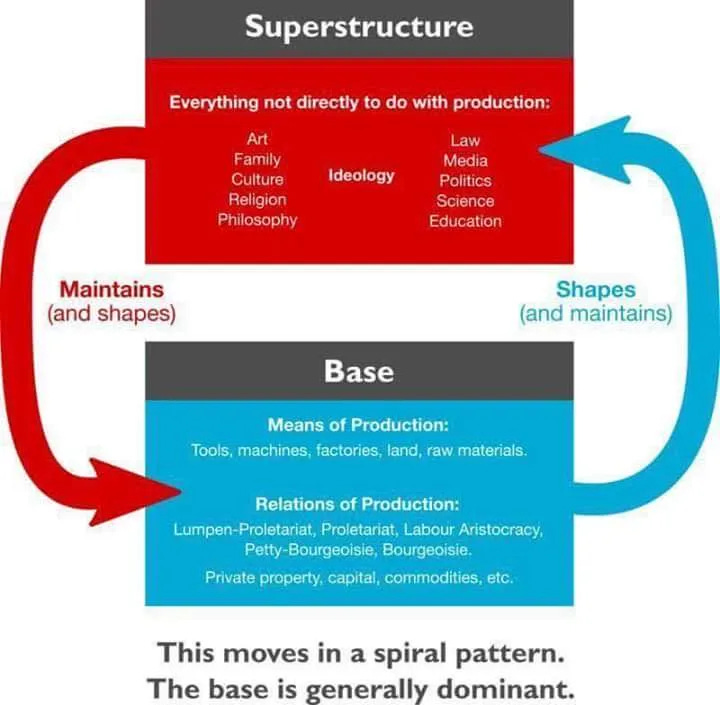
Material Base: The mode of production, consisting of productive forces and relations of production, constitutes society's material foundation. Changes in this economic base ultimately determine changes in the political, legal, and ideological superstructure.
Class Struggle: In class societies, the fundamental contradiction exists between classes with opposing interests. The struggle between these classes drives historical development and creates the conditions for revolutionary transformation.
Historical Stages: Human society develops through distinct stages, primitive communism, slavery, feudalism, capitalism, socialism, and communism, each characterized by specific contradictions that generate the conditions for transition to the next stage.
Revolutionary Transformation: Historical development occurs through revolutionary leaps where accumulated contradictions resolve by transforming the entire social system. These revolutions represent qualitative transformations in social organization.
The transition from capitalism to socialism exemplifies dialectical development. Capitalism creates the conditions for its own negation by developing social production while maintaining private appropriation, generating the contradictions that make socialist revolution both possible and necessary.
Historical materialism reveals that social formations are not eternal but temporary arrangements that develop and perish according to dialectical laws. This understanding provides the scientific foundation for revolutionary practice aimed at conscious social transformation.
Conclusion
Dialectics as the Logic of Revolution
The dialectical method represents humanity's most advanced approach to understanding reality's contradictory, interconnected, and developing character. From recognizing the limitations of formal logic through Hegel's idealist systematization to Marx's materialist transformation, dialectics has evolved into a scientific method for analyzing and transforming both natural and social reality.
Understanding dialectical materialism requires grasping its development as a unity of opposites: it preserves valuable insights from previous philosophical traditions while negating their limitations through materialist synthesis. This negation of negation creates a higher form of understanding that transcends the opposition between materialism and dialectics by uniting them in revolutionary practice.
The dialectical method remains indispensable for understanding contemporary reality and participating in its transformation. As capitalism's contradictions intensify globally, dialectical materialism provides both analytical clarity for understanding these contradictions and practical guidance for their revolutionary resolution.
Mastering dialectical method demands uniting theoretical study with practical engagement in social transformation. Only through applying dialectical principles to concrete struggles do we develop genuine understanding of their revolutionary potential. The dialectical method is not abstract philosophy but the logic of revolutionary practice, the theoretical weapon of those who seek not merely to interpret the world but to change it.
Dialectics as Revolutionary Science
Dialectics is not mere abstraction, it is the science of revolution. It teaches us that no system is eternal, that contradictions exist within every order, and that history can be changed through struggle, rupture, and synthesis. Marx, Engels, Lenin, Stalin, Mao, and others used dialectics not as philosophy alone but as a weapon of proletarian power.
The dialectical method is for those who wish not only to understand the world, but to change it. As Marx declared:
“Philosophers have only interpreted the world; the point, however, is to change it.”
Further Reading and Study
Key Texts:
Introductory Videos: